Concurso UVA Orfelinato
Open competition entry, UVA Orfelinato
- Status
- Competition entry
- Year
- 2013
- Location
- Medellín, Antioquia
- Area
- 14,300 m²
- Design
- Eduardo Mejía Martínez, architect, and others
Design statement
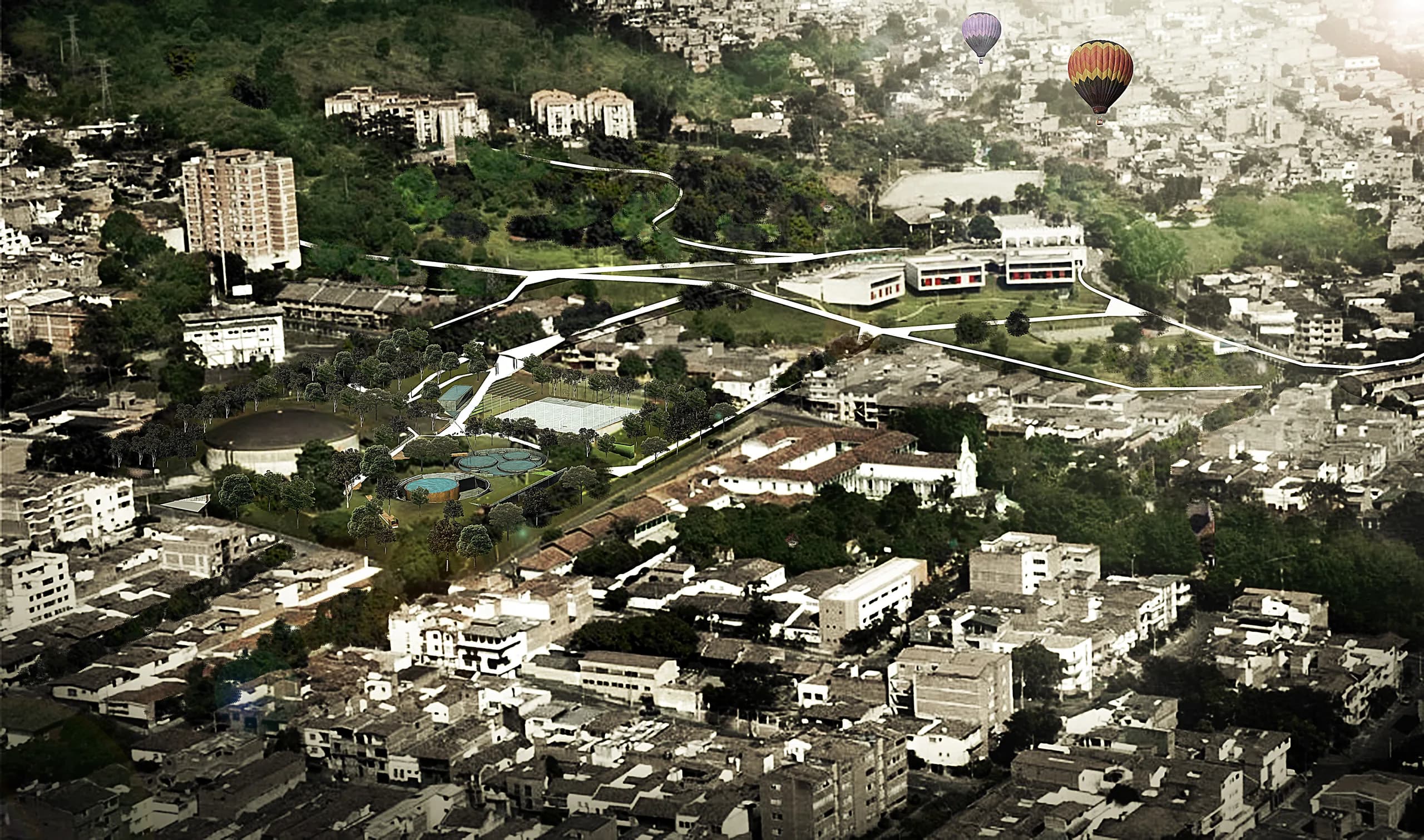
The UVA Orfelinato project (a UVA, or Unidad de Vida Articulada, is one of the small civic and recreational buildings built on the water-tank sites of Colombian cities) redefines what public architecture can be by proposing an infrastructure that not only serves practical purposes but builds a sensitive spatial experience. Through an architectural route connecting three main entrances, the design establishes a direct relationship with the topography, the daylight and what is already on the site, producing a sequence of immersion by means of cuts in the ground, shade and planting.
The proposal is organised from a hierarchical reading of the brief: auditoriums and classrooms as the backbone, with further ancillary spaces that allow community uses. Cultural and educational spaces are brought together with publicly accessible areas and interior ones, activating the place with uses such as ICT rooms, internet cafés and small local shops. This strengthens the social dimension of the project and reinforces its value as immersive public space.
The landscape criteria start from planting set out on a grid, intended to soften rigid lines as the species grow. This approach to landscape complements a cultural infrastructure that evolves over time, able to become a “useful ruin” as part of the legacy of the city.
The project is therefore an example of sustainable urban design and urban renewal that ties the functional to the symbolic. It is a piece that brings tactical urbanism, architectural landscape and community activation together in a single built gesture.
Gallery
Related projects
We need to get a public project built.
Schools, cultural centres, administrative offices and public space. It is where most of our work is, and where the studio’s four competition awards come from, three of them national public competitions.