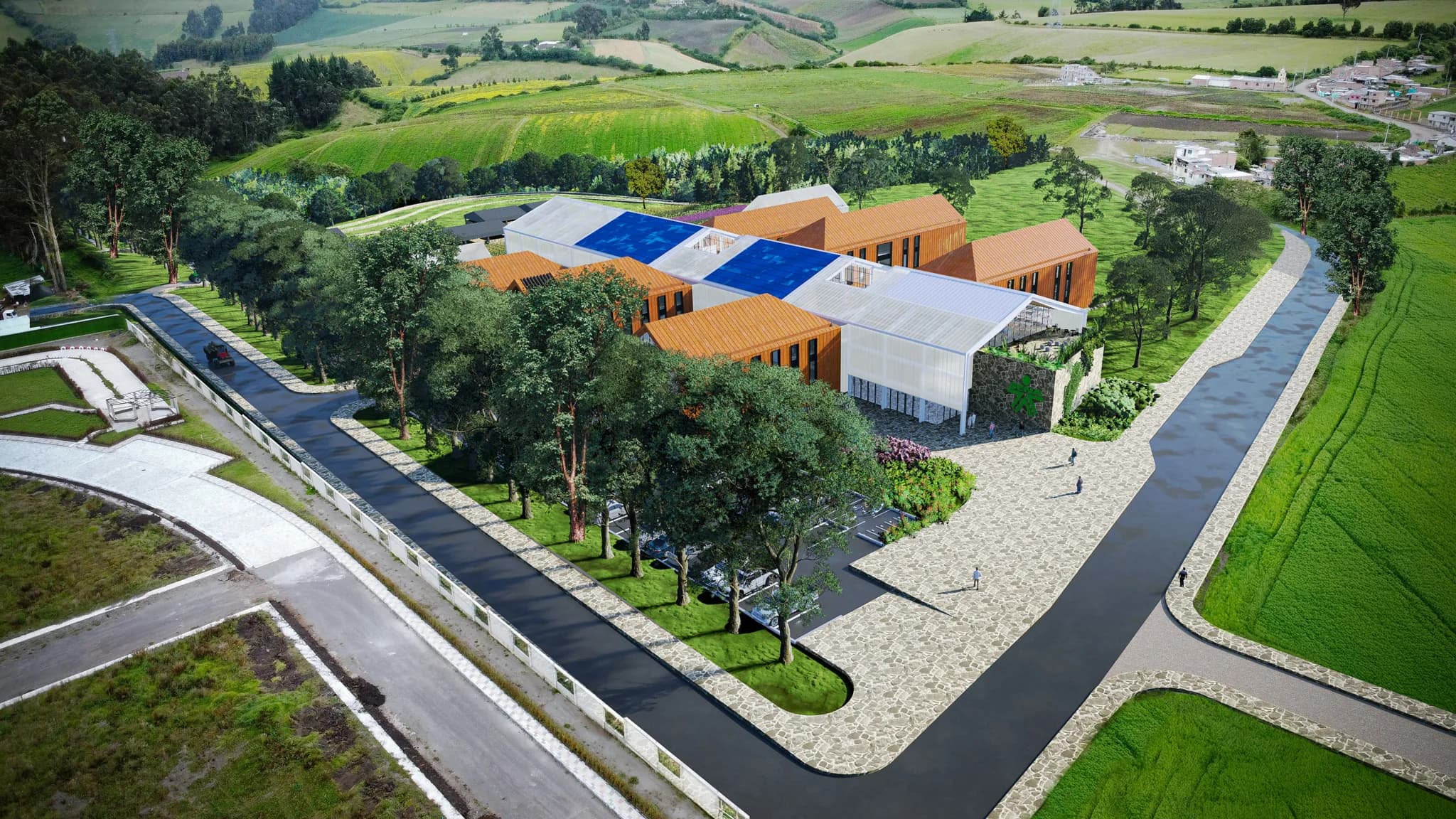
Concurso 5inco Sena Ipiales
Competition entry, Concurso 5inco, SENA Ipiales
- Status
- Competition entry
- Year
- 2024
- Location
- Ipiales, Nariño
- Area
- 10,561 m²
- Design
- Eduardo Mejía Martínez, architect, and others
Design statement
The new Centro de Formación Sur Colombiano for SENA (the national vocational training service) stands in the municipality of Ipiales, Nariño, and is conceived as a regional technical training facility. Its design answers a rural and productive context, bringing vocational training together with a careful reading of the landscape. The building settles onto the ground organically, following the contours, to give an efficient and accessible infrastructure fitted to its surroundings.
The brief is organised into four main teaching blocks: industry, humanities, hospitality and tourism, and agriculture. Each one works fairly autonomously, but all are linked by a large transverse shed that organises the shared areas of the project. This shed gathers the support spaces (auditorium, library, cafeteria, services and administration) and acts as the hinge between the main Ipiales–Aldana road and the farmland at the back of the site.
The building has two internal circulation systems: a pedestrian one linking the teaching areas, and a service one allowing direct access for supplies, produce and waste. This operational logic keeps the building quick and flexible in use, and allows efficient logistics for practical training and real production.
Formally, the complex takes up the archetype of the agro-industrial shed, recognisable and functional, with a modular, lightweight and economical structure. The blocks rest on stone plinths that recall the legacy of the Qhapaq Ñan, the Andean road system, tying constructional tradition to a technological outlook. The result is a rural training centre with a strong educational, logistical and cultural impact for southern Colombia, one that brings sustainability, relevance and a productive vocation together in a single project.
Gallery
Related projects
We need to get a public project built.
Schools, cultural centres, administrative offices and public space. It is where most of our work is, and where the studio’s four competition awards come from, three of them national public competitions.